
GuideMatching
URL matching and conditions
Four match modes, request methods and conditional hits by query, header, JSON body or GraphQL operation.
Every rule starts with a match: a request method plus a URL pattern in one of four modes. Rules are evaluated in order — projects top to bottom, rules within a project top to bottom — and the first enabled rule that matches wins.
Match modes
| Mode | Pattern example | Behaviour |
|---|---|---|
| Contains | /api/users | Matches when the full URL or the path contains the string |
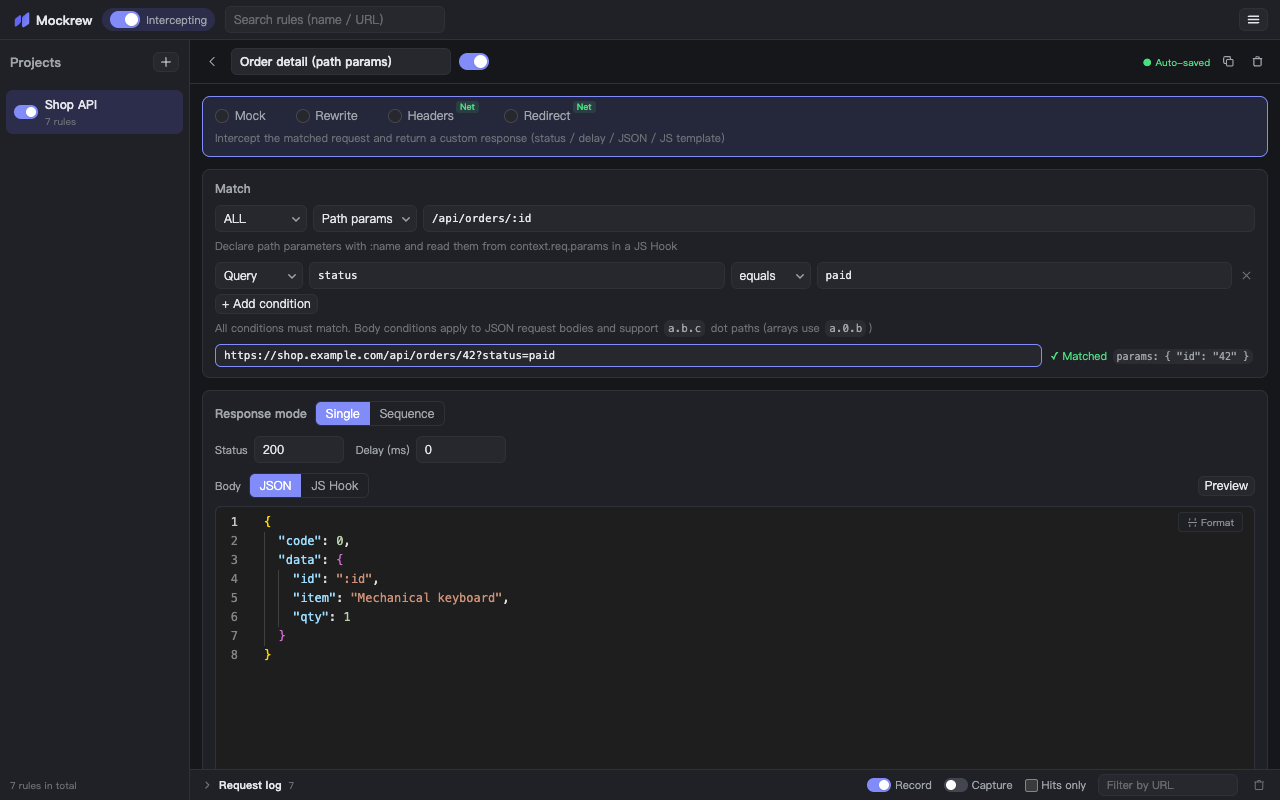
| Path params | /api/orders/:id | Matches segment by segment; each :name becomes a parameter readable in a JS Hook as context.req.params.id |
| Exact | /api/users | The full URL or the path must be exactly equal (query string included when you type one) |
| Regex | /users/\d+$ | A regular expression tested against the full URL |
Use ALL to match any method, or pick GET / POST / PUT / PATCH / DELETE / HEAD / OPTIONS. fetch requests and XHR requests are treated the same way.
/ or scheme is matched as a plain substring — users also hits /api/users and /v2/users-legacy. Prefer /api/users.Conditions
Conditions narrow a match further. All conditions must match for the rule to hit; there is no OR group. Four sources are supported:
| Source | Key example | Notes |
|---|---|---|
| Query | type | A URL query parameter, e.g. type equals vip. Repeated parameters are compared as a list. |
| Header | x-token | A request header; useful for authorization, content-type or custom debug headers. |
| Body | data.type | A JSON request body field. Dot paths reach nested fields; arrays use data.list.0.id. |
| GraphQL | operationName | Only accepts operationName, operationType, query and variables (including variables.* dot paths). |
Each condition supports four operators: equals, contains, exists and regex. exists only checks that the key is present, whatever its value.
Test a URL
The test URL box under the conditions verifies matching instantly: it shows ✓ Matched (with the extracted path params) or ✗ No match. It is a pure string test — it does not send a request, so it cannot evaluate conditions that need real traffic.
Ordering and shadowing
Because the first match wins, a broad rule placed above a narrow one hides it. Two habits avoid most surprises: put specific rules (path params, exact URLs) above generic ones (Contains on a common prefix), and use conditions instead of duplicating rules for every variant.
What is matched against
- The full URL including scheme, host, path and query — for all four modes.
- The path only as a fallback, so
/api/usersmatcheshttps://api.example.com/api/users?page=2. - Fragments (
#…) are never part of the request URL and are ignored. - Case sensitivity is preserved; add a regex with
i-style alternatives if you need case-insensitive matching.
Stuck, or need something clarified? support@mockrew.com·Terms of Service